
Last month, the NPL team, led by Gavin Sutton and Aldo Mendieta, successfully recommissioned and calibrated their standard flame developed during the previous EMPRESS projects. The NPL STD flame provides a region of stable, reproducible gas temperature and composition that can be used to calibrate optical thermometers. The system is calibrated using laser Rayleigh scattering, where the strength of the scattered beam is inversely proportional to temperature. If the scattered beam power is measured for room temperature air (also measured by a traceable platinum resistance (PRT)) and then for the flame, the ratio of the two gives the approximate ratio of the two temperatures. NPL have developed dedicated software and iterative correction algorithms to take this ratio and determine the true flame temperature with an uncertainty of less than 0.5 %. Since the technique is optical, the delicate flame environment remains unperturbed during the measurements.

Figure 1 shows the STD flame during the calibration process – the green laser beam passes through a region 20 mm above the stabilised flat-flame and the Rayleigh scattered light is collected perpendicularly (on the right hand side of the figure) and imaged onto a sensitive silicon trap detector, where the scattered power is converted to a voltage and measure by a PC via a DACQ card.
Following recommissioning, the STD flame has been calibrated for propane/air flames with equivalence ratios from 
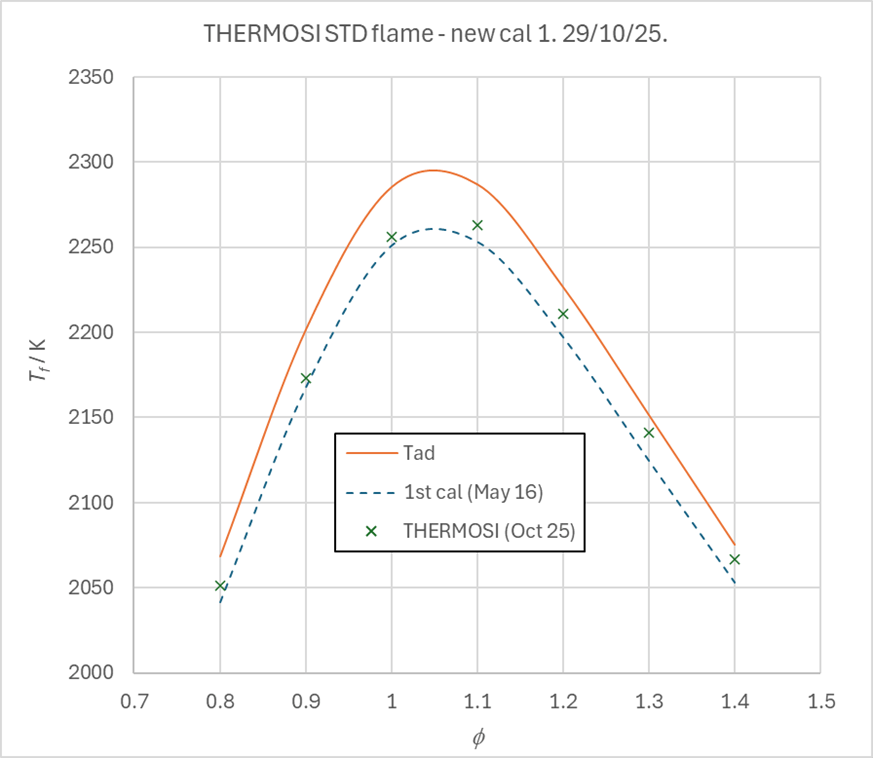
Figure 2 shows the new calibration result and compares it to a) the adiabatic flame temperature (the maximum temperature achievable if there was not heat loss to the burner surface – never seen in practice), and b) the original flame calibration performed 9 years previously under the EMPRESS project. The agreement for measurements made 9 years apart is remarkable.
Finally, we show the drift in measured flame temperature since the original calibration, where 7 re-calibrations were made during the EMPRESS and then EMPRESS 2 EU projects. We see that the new measurements with the new set-up, made 9 years after the original calibration (black coloured in circles), are systematically higher by approximately 10 ± 6 K. This is a good result. We note that the original flame temperature calibration is estimated to have an uncertainty of 0.45% of temperature, or approximately 10 K. If we assume a similar uncertainty for the new measurements, they agree with the original measurements within their combined uncertainty. It was necessary to use a new bottle of propane for these tests as the last was discarded some years ago. Small differences in the gas composition could cause the slight increase in flame temperatures, but further analysis will be needed to confirm this.
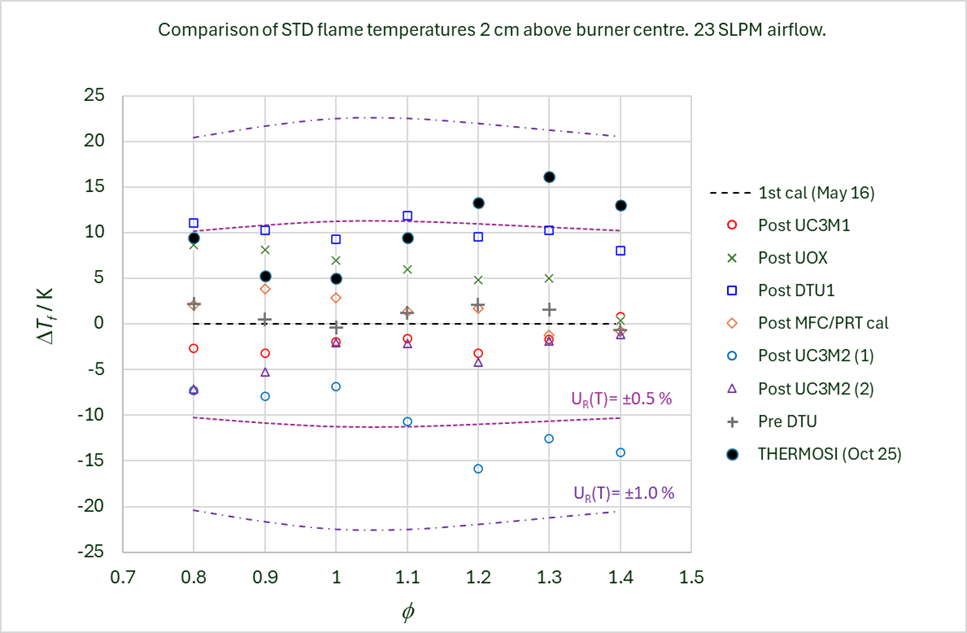
Figure 3 shows the drift in the NPL STD flame over 9 years from 2016 to 2025, for various equivalence ratios for propane/air combustion.
Next year, the STD flame will be transported to DTU to be used as a calibration source for spectroscopic temperature measurements being pioneered at the Danish laboratory also as part of the THERMOSI project.


 23IND11 ThermoSI
Leave a comment