
As part of WP3 – thermographic phosphor thermometry up to 1250 °C, NPL have performed initial tests on one possible candidate high-temperature phosphor, YAG:Dy. Using a simple optical set-up, a high-temperature furnace and a simple grating spectrometer, the luminescence spectra of a YAG:Dy coated target have been successfully measured from room temperature up to 1140 °C. Analysis of these spectra has identified a strong intensity ratio (IR) response for bands centred at 460 nm and 480 nm and optical bandwidths of 10 nm.

Experimental set-up for capturing the YAG:Dy luminescence spectra versus temperature. The LED light (from a high-power 365 nm LED) is delivered via a simple two lens system from the LHS onto a dichroic mirror that reflects the light onto the phosphor sample and allows the fluorescence to pass back on to a collimating lens and into a fibre coupled spectrometer.
The measured spectra are given below, showing the optimum bands for IR phosphor thermometry for YAG:Dy. Generally, the intensities of the bands centred at 460 nm and 490 nm increase and decrease respectively as the temperature increases, giving a strong temperature sensitivity. Additionally, since the emission of interest is in the blue region of the spectrum, the signals are not overwhelmed by background blackbody (thermal) radiation.

The following figure shows the intensity ratio response, IR(T) = I(460nm) / I(490nm), extracted from the spectral data given above. Two thermal cycles are shown that appear to be similar.
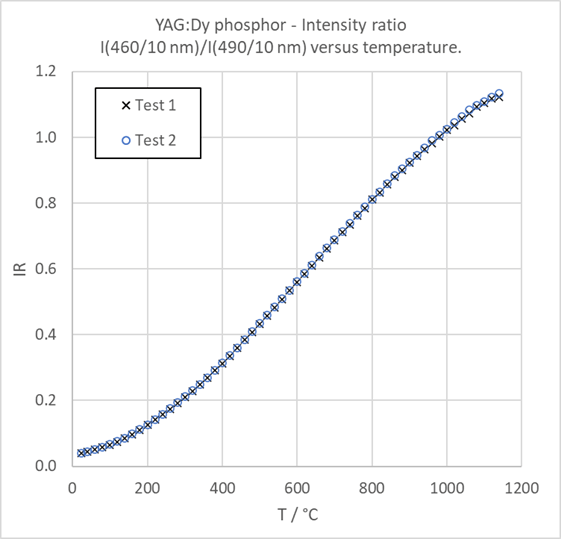
Work delivered during the previous Euramet project EMPRESS 2, using a different thermographic phosphor MFG, achieved a maximum temperature of 750 °C. This new work delivered as part of the ThermoSI project has demonstrated that higher temperatures are possible for phosphor thermometry, and that the target maximum temperature of 1250 °C may be possible. This will allow NPL to trial phosphor thermometry in higher temperature industrial processes such as steel re-heating prior to rolling, for example, planned for year 3 of this ambitious project.
For further information, please contact: Dr Gavin Sutton (gavin.sutton@npl.co.uk)


 23IND11 ThermoSI
Leave a comment