
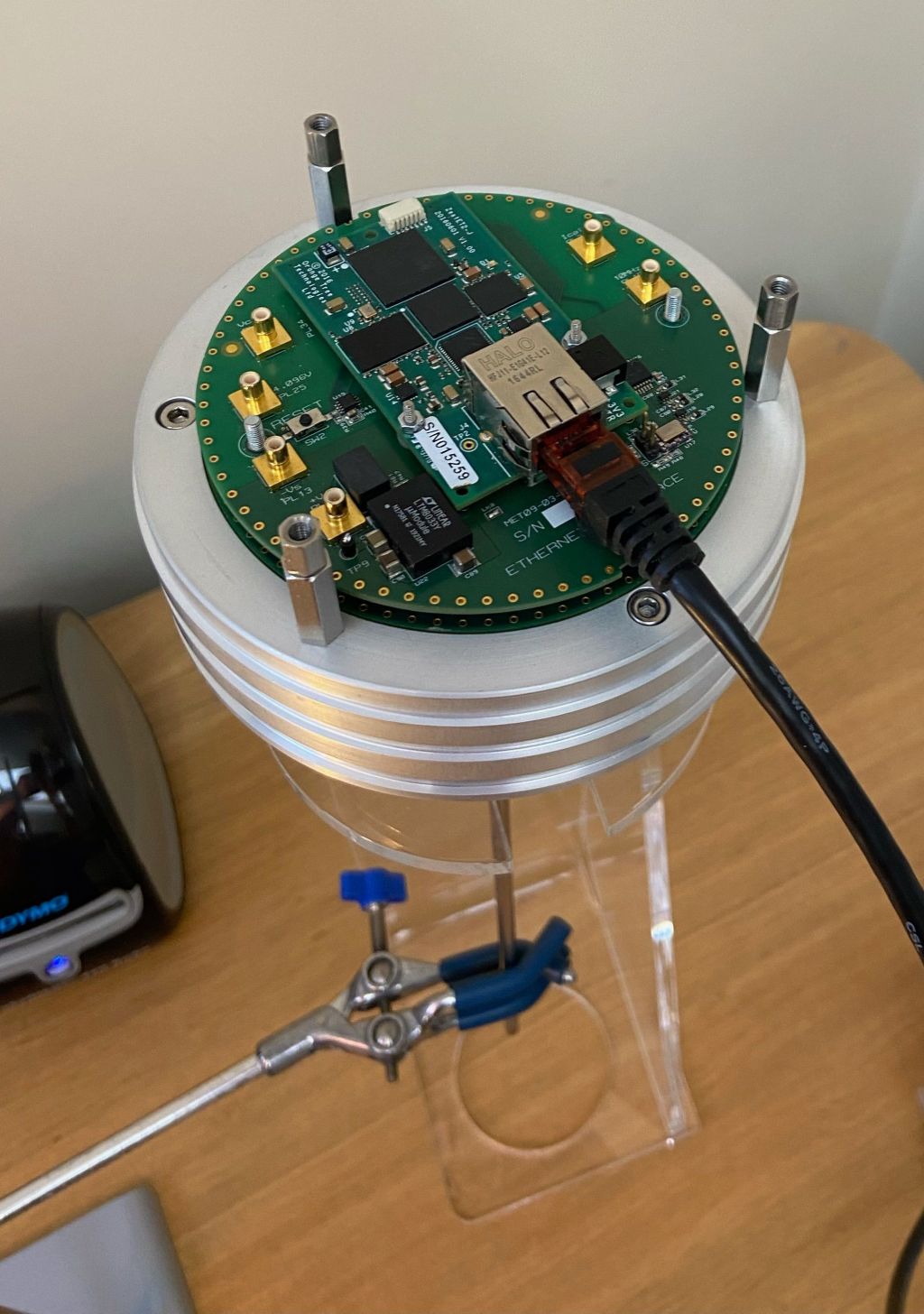
Johnson noise thermometry (JNT) is, in principle, immune to calibration drift due to sensor degradation in harsh environments. Recently, new JNT concepts have been introduced and are currently being finalised.
The Metrosol IJNT is designed for temperature sensors in the kilo ohm range and has a wide measurement bandwidth to allow short measurement times. It performs simultaneous calculation of the sensor resistance and system frequency response as well as the Johnson noise power. The University of Ljubljana ULNT is based on the Metrosol approach but involves a commercial sound card for data acquisition and a wideband transformer for injecting the reference signal. The Czech Metrology Institute CMINT is based on two channel noise measurement, using low noise discrete FET transistors with high input impedance, connected in parallel. In contrast to the other JNTs, the PTB ‘DART’ JNT involves only a single highly stable and linear signal channel that is calibrated with a Josephson arbitrary waveform synthesiser (JAWS). The spectral density of the thermal noise in the sensing resistor is determined directly in a sequential measurement procedure without the need for correlation techniques. Since the DART simultaneously measures the resistance and the noise of the temperature sensor, it combines noise and resistance thermometry.
The aim of this work package is to establish the operational readiness of the new JNT concepts outlined above for industrial applications (e.g. nuclear decommissioning and waste storage, high value heat treatment). This includes concepts for and demonstrations of calibration, traceability, and temperature measurements at fixed points as well as at industry-relevant temperatures.
- In the first task metrological characterisation of the JNTs will be performed and the achievable measurement uncertainty with the calibrated instruments will be demonstrated. Due to the small amplitude of the thermal noise, external electromagnetic interference is a severe problem in JNT so the electrical shielding will be improved to achieve a target uncertainty of less than 3 °C at 1200 °C.
- The second task addresses the development and testing of robust sensor elements which are usable for temperature measurements up to about 1200 °C. This includes measurements in harsh environments (high temperature, electromagnetic fields) and susceptibility of the sensor to ionisation radiation.
- Finally in the third task, a comparison of the JNT systems will be carried out and uncertainty budgets developed.


 23IND11 ThermoSI
Leave a comment